
1 INSIGHT
Cross-dock distribution centers are built for flow, not storage.
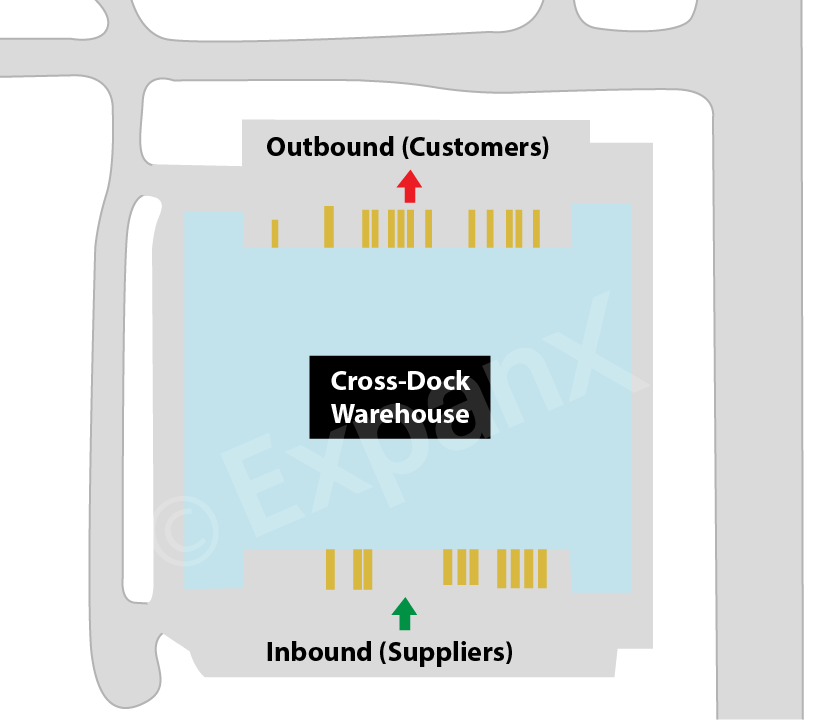
Inbound freight from suppliers is received on one dock side, quickly sorted or consolidated, and transferred to outbound trailers serving customers on the opposite side, often within hours.
As customers expect faster fulfillment, freight cycles have compressed to hours, not days – execution now comes down to:
- Dock door ratio (often 1 door per 2,000–5,000 SF depending on throughput)
- Truck court depth (typically 120’–185’ for 53′ trailer maneuverability)
- Trailer parking/staging capacity
- Clear separation of inbound and outbound truck circulation
In cross-dock operations, layout efficiency drives operational efficiency.
2 ACTION STEPS FOR INDUSTRIAL TENANTS
- Evaluate Dock & Court Metrics – Not Just Square Footage
Confirm:
– Adequate dock door count on both sides
– Sufficient spacing between doors
– 120 feet or more of truck court depth (deeper for high-volume facilities)
– Room for simultaneous backing without multi-point turns - Map Inbound vs. Outbound Flow Conflicts
Ensure:
– Suppliers and customer shipments do not cross circulation paths
– Entry and exit points support peak-hour volume
– On-site truck circulation allows continuous flow without bottlenecks
– Throughput facilities cannot tolerate friction
3 KEY TAKEAWAYS
Cross-dock facilities succeed on flow efficiency, not storage depth.
Dock count, truck court depth, and trailer staging directly impact daily capacity.
Efficient separation of inbound (suppliers) and outbound (customers) flow reduces labor cost per load and improves delivery reliability.